


The Local newsletter is your free, daily guide to life in Colorado. For locals, by locals.
Lately, hardly a day can pass without another disturbing headline detailing alleged abuses of power by U.S. Immigration and Customs Enforcement: the fatal shootings of Alex Pretti and Renee Good; five-year-old Liam Conejo Ramos’ detainment; face-covering bans, including one newly approved by Denver City Council; and seemingly endless apartment raids.
Americans have no shortage of anecdotal evidence that ICE enforcement is increasing around the country, but a new analysis from economists at the University of Colorado Boulder provides hard numbers to back that up—and quantify just how massive the increase has been.

The study—authored by CU Boulder economists Chloe East and Elizabeth Cox, with University of California Berkeley colleague Caitlin Patler—examined 10 years of data from the Department of Homeland Security. The data, which includes details on ICE arrests from October 2015 to October 2025, has been collected over time through Freedom of Information Act requests and lawsuits. (If you want to poke around the raw numbers yourself, you can access them on the Deportation Data Project’s website.)
“I think a very reasonable question about anything that is coming out of DHS right now is, ‘How reliable is the information that they’re providing?’” says East. In an effort to validate the data from DHS, researchers compared the overall patterns of the statistics the agency shared with other sources of information about ICE activity, like media reports and other DHS data, to see if they matched, East says. Statistics reported by DHS about people ICE has arrested with criminal backgrounds are often inflated because they include charges and convictions; the CU Boulder analysis only identifies people with criminal convictions. “That was an intentional choice that we made because there’s a lot of reasons to think that the criminal charge classification that’s available in the data is not very reliably measured,” East says. “There’s reporting that ICE is overclassifying people as having criminal charges.”
Once the team was able to move forward with reliable data, they zeroed in on two specific periods: The beginning of Trump’s first term and the beginning of his second term. We asked East to discuss some of her most illuminating findings, how ICE’s arrest tactics have changed over time, and if the Trump administration is actually targeting “the worst of the worst.”
1. Although ICE is arresting more people, fewer are convicted criminals.
One promise the Trump administration has kept is its commitment to ramping up ICE activity. Researchers saw a spike in ICE arrests immediately following both of Trump’s inaugurations, but the surge after he was installed for his second term was astronomical. In the first 10 months of Trump’s second term, average daily ICE arrests jumped 170 percent from Joe Biden’s final year in office. ICE arrests also increased during the first 10 months of Trump’s first term, but only by a modest 43 percent. So if it seems as though the president massively scaled up ICE operations this time around, it’s because he did.
The Department of Homeland Security (DHS) claims that these extensive ICE operations are “removing the worst of the worst criminal illegal aliens from American communities, including murderers, rapists, pedophiles, drug dealers, and more,” according to a DHS press release. But the CU Boulder analysis revealed that isn’t exactly how it’s playing out.
“We show that every time there’s been an increase in ICE arrests, the percent of people who are arrested who have a criminal conviction falls,” East says. “So actually, the scaling of ICE activity leads to ICE doing a worse job at targeting people with a criminal conviction, which is very counter to the political rhetoric.”
In the first 10 months of 2025, only 37 percent of people arrested by ICE had criminal convictions, compared to 52 percent in Biden’s final year. East also likes to remind people that just because someone is living in the U.S. without documentation doesn’t mean they’ve committed a crime. In fact, most immigration infractions (like overstaying a visa) are civil infractions.
2. ICE is arresting more people in public spaces.
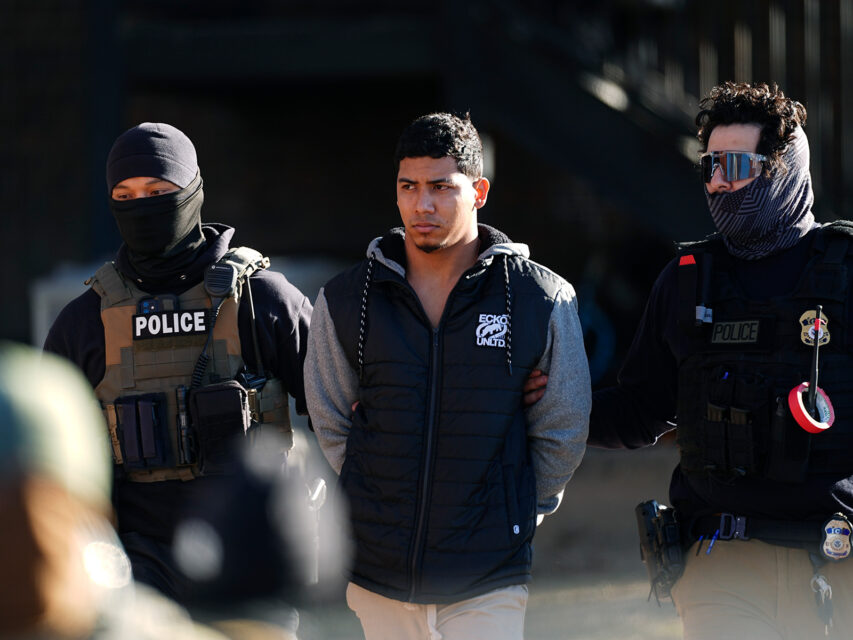
The study divides arrests into two types: community and law enforcement agreements. Community arrests are the ones that make headlines; they occur in places like parking lots, courthouses, apartment complexes, and on public streets. Law enforcement agreement arrests are when ICE detains someone who is already in police custody. “What we see is in the second Trump administration, there’s much less reliance on these law enforcement agreement arrests that focus on people already in custody, and much more reliance on community arrests that are very indiscriminate in nature and pick people somewhat randomly out of the community,” East says. The CU Boulder study shows that in the first 10 months of Trump’s second term, nearly half of all ICE arrests took place in the community, compared to only 22 percent in his first term. “That explains some, but not all, of the worsening in targeting of [people with criminal convictions] in the second Trump administration.”

Despite community arrests being less effective at detaining people with criminal convictions, the Trump administration continues to lean on them heavily, perhaps because they’re easier to scale, East says. This trend was particularly noticeable in late spring 2025, when Trump aide Stephen Miller declared that ICE should be aiming for 3,000 arrests daily. Immediately following this announcement, daily ICE arrests jumped to about 1,200, the majority of which were community arrests.
3. Denver experienced the sixth-largest spike in ICE arrests in the country—and only about 40 percent have a criminal conviction.
The Trump administration has been clear about its desire to crack down on Democrat-led “sanctuary cities,” and the data backs that up. ICE arrests in Denver soared 211 percent at the beginning of Trump’s second term. The only areas that saw larger jumps? Atlanta, Boston, El Paso, San Diego, and Washington, D.C.
During the last year of the Biden administration, Denver saw an average of fewer than five daily ICE arrests. In Trump’s second term, there have been 15 to 25 arrests a day. Only about 40 percent of people arrested by ICE in Colorado have a criminal conviction. “It very much mirrors what we see at the national level,” East says. Like other cities helmed by Democrats, Denver saw a boom in community arrests during Trump’s second term—to the tune of 265 percent.
Colorado is also home to a massive immigration detention center in Aurora—and there are murmurings of another that may open in Hudson. While collecting data for the larger ICE analysis, East dove into the Aurora statistics. The average number of people held daily at the Aurora detention center went up from about 1,100 during the final year of the Biden administration to roughly 1,400 during Trump’s second term. How many of those 1,400 people have criminal convictions? About 20 percent, East says.
“I think a lot of people have now firsthand experience seeing ICE in their communities, and they hadn’t before,” she says. “But we really wanted to put hard data behind the reporting and behind those firsthand experiences that people have been having.”