


The Local newsletter is your free, daily guide to life in Colorado. For locals, by locals.
The night before, Jessica and I had pitched our tent on a soft sandbar beside a spring-fed creek, deep within a far-flung canyon. Others had found this sanctuary before we did, leaving behind burgundy swirls painted inside a nearby alcove, images of deer and horses pecked into a pink sandstone wall, and the long-abandoned detritus of a mining attempt scattered in the scrub. But among the living, only a pair of bighorn sheep tracks pressed into the mud near the water’s edge hinted we might not be alone.
If we had stayed at that campsite, tucked in the northern folds of the Dominguez Canyon Wilderness on the Western Slope, we could have spent the following day scampering up to a mesa for a view of the distant Elk Mountains, scouting for ungulates tiptoeing on narrow ledges, or investigating petroglyph panels. I might have lazed on a sunbaked boulder and cracked open my book, a tattered copy of Desert Solitaire, the great conservationist Edward Abbey’s recounting of two seasons spent tending a lonely outpost of Arches National Monument on the Colorado Plateau. A small stream in a desert canyon is “the most precious thing on earth,” he wrote, describing an oasis just like this one.
But I’m an idiot—a Front Ranger hooked on peakbagging and crossing line items off my ever-increasing bucket list. My quarry this time: a multiday backpacking trip on the Uncompahgre Plateau. Determined to complete my quest in the neat, weekendlong window life had allotted, I decided to abandon that Edenic site in pursuit of parts unknown. Which is why we now find ourselves exhausted, miles from any sort of suitable camp, somewhere in the jaws of Big Dominguez Canyon.
Shouldering heavy overnight packs—loaded with emergency winter gear and a gallon of water each—we navigate a jigsaw puzzle of ascents and descents along a shelf in the chasm. I stop to consult our topo map often. The path is faint and unmarked, less a trail than a suggestion across rocky washes and barren desert, and we drift onto game trails multiple times. I apologize to Jessica for promising a quick jaunt. “It’s alongside a river, gotta be flat,” I’d said when I was selling her on the adventure a few weeks back. “We’ll cover at least two, probably three, miles per hour.” We wander toward the water before a two-story-tall drop-off forces us to turn around and climb a cacti-riddled boulderfield to regain the main drag.
By 2 p.m., we’re nearing 10 miles on the day—a smidge over one mph—and a couple thousand feet of elevation gain. My thighs are cooked. We doff our packs and shimmy onto a California-king slab of schist, its sparkly charcoal-colored surface angled northeast toward the confluence of the Dominguez and Gunnison rivers, where we came from. Upcanyon, house-size boulders teeter atop skinny spires and thousand-foot-wide alcoves in the sandstone walls cast long shadows across the path. Jessica dumps electrolyte tabs into our Nalgenes and unearths tuna kits from her pack while I make calculations. We have five to 10 more miles until we reach our next campsite.
“That’s a big range,” Jessica deadpans, handing me a mayo packet for my tuna salad.
Big Dominguez Canyon first popped up on my radar in 2017, when I edited a story about it while on the masthead at now-defunct Backpacker magazine. We recommended a 35-mile circuit that followed Big Dominguez Creek, a tributary of the Gunnison River, and looped back through even lesser-known Little Dominguez Canyon, with an off-trail section in between. The writer lauded it as the “Best Winter Hike for Escaping the Cold,” touting its “manageable temps” (average highs are in the 50s) and “seasonal quiet.”
The route became the preferred choice for anyone looking for an awesome desert backpacking trip in Colorado, be it because they wanted to see fantastical terrain that didn’t include mountains or they wanted to go backpacking outside of the state’s otherwise narrow (July to September) backpacking season. We even included it on 5280’s list of Colorado’s 50 best hikes (number 41), which we published in 2024.
But here’s the rub: I remained unconvinced that Big Dominguez is awesome. It is far away, with no mountains, and when I looked it up online, I saw images of train tracks and a manmade bridge spanning a river the color of chocolate milk. Water sources are sparse, and carrying your water on a 40-miler is a pain. The majority of the loop isn’t on trails, so completing it requires serious route-finding chops.
Worse, I couldn’t seem to find any reliable information about the place. Online reports suggested the route could actually be closer to 50 miles. One blogger said it took him a week; another lamented that it was unsigned. At the checkout counter at my local REI Co-op in Boulder, where I was buying a fuel canister and a couple of backpacking meals, I asked the clerk if I had missed the Dominguez Canyon Wilderness area map on the shelves while browsing. He had never heard of it.
When I texted a former Backpacker colleague about the route, he replied, “Ah, the Big D. [A mutual friend] tried it but got lost and possibly discouraged. He backtracked and bailed. I still think about that hike when I drive west but haven’t done it.”
Despite its notoriety, the Big Dominguez appeared to be unknown and unexplored. I sensed an opportunity to verify the credentials of one of Colorado’s most hyped hikes while simultaneously collecting a trophy few others seemed to have. So this past winter, I carved out four days and hoped it was 35 miles.
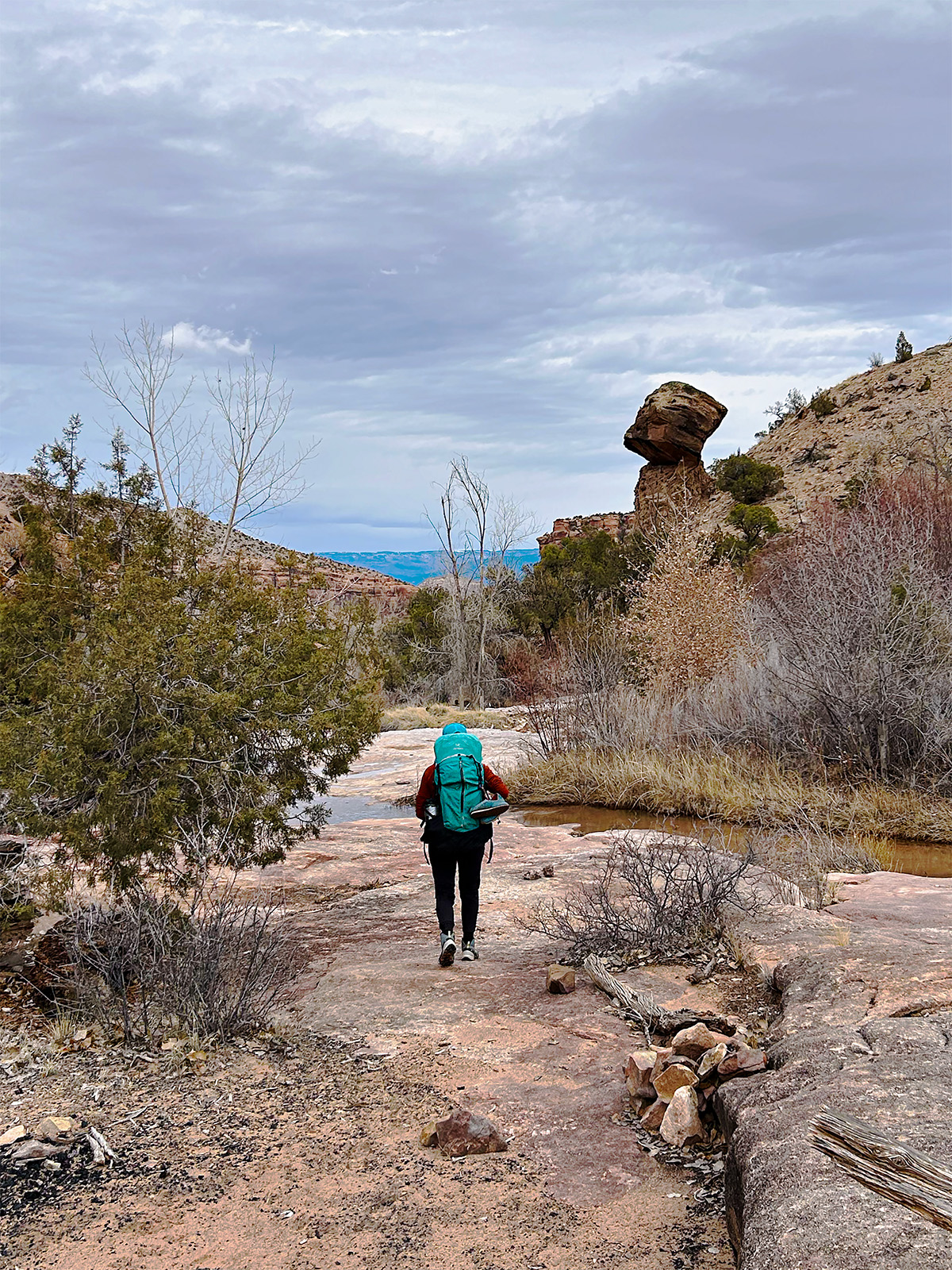
After a couple of false starts—one hiking partner landed a new job and couldn’t score PTO, and my second and I were thwarted by a 50-car pileup on I-70 near Glenwood Springs—I asked my understudy at this magazine if she’d come along. Jessica Giles is young and fit; she trail runs for fun. More importantly, she’s chatty—always a virtue when wandering through the desert. I told her that I’d plan our meals and itinerary and loan her ultralight overnight gear. “I need a partner in case it goes off the rails,” I said, trying to crack a joke about the train tracks we would be following. She asked me if she should be nervous. “No,” I hedged, promising her a couple of days out of the office that wouldn’t count against her PTO to sweeten the deal. “I’ll do it for the plot,” she said.
On a mild morning in mid-February, we loaded overnight packs into the back of my truck, rebooted my Garmin service, and headed west for unincorporated Bridgeport and its eponymous trailhead.
The first few miles of the trip were as uninspiring as I’d feared. From the banks of the slow-moving Gunnison River, the crumbly facade of Big Dominguez Canyon looks like a pile of brown laundry tossed in the corner of a dorm room. We followed a gravel railbed and paused to let a freight train rumble through on its way to Denver. We passed a dusty campground and walked on a dirt doubletrack, dodging piles of horse poo. “ ‘May your trails be crooked, winding, lonesome, dangerous, leading to the most amazing view,’ ” I quipped to Jessica, quoting Abbey, as we crossed a cattle grate.
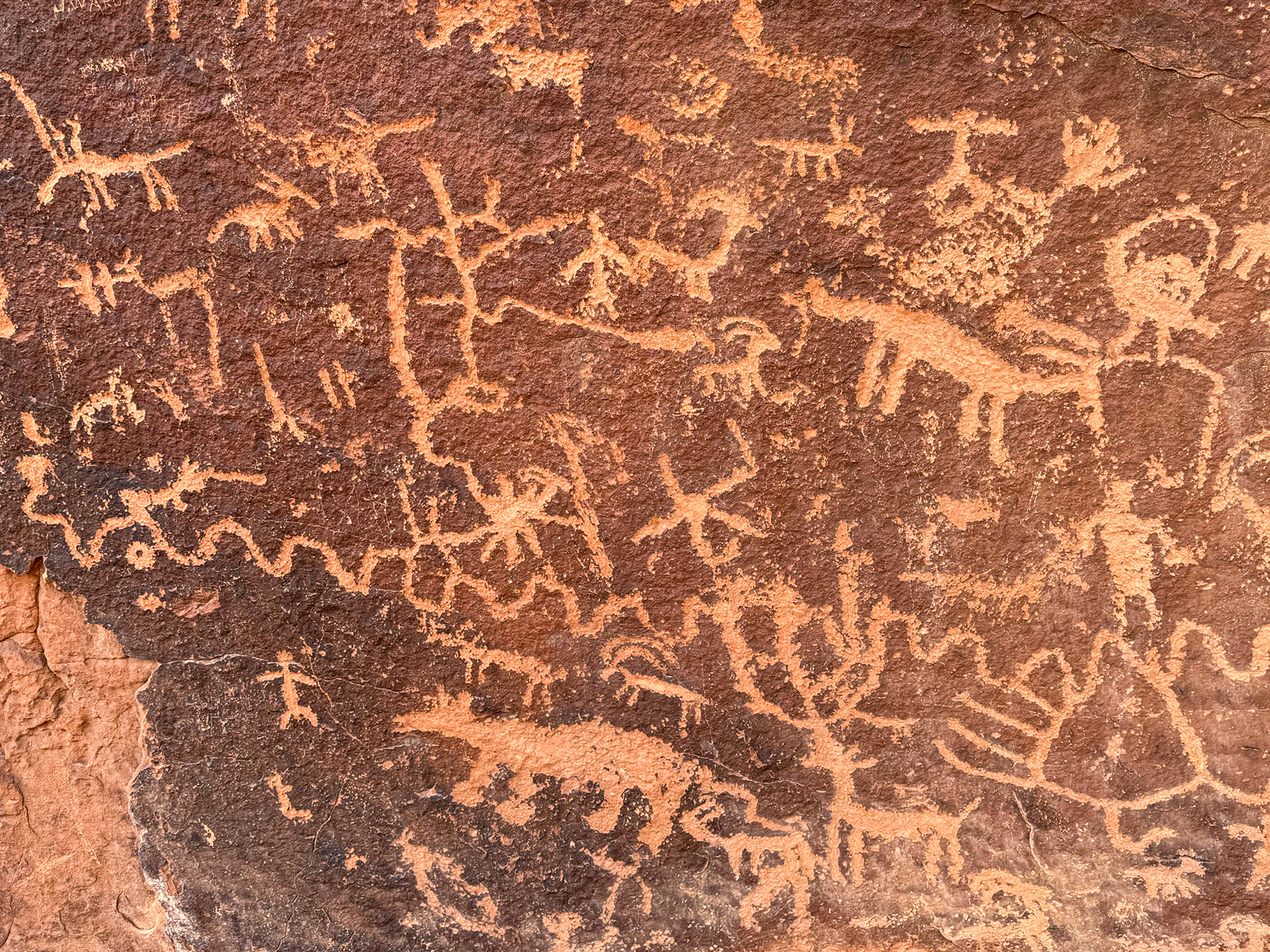
But not three miles into our hike, we came upon a petroglyph panel—massive, the size of a bedroom wall—preserved mere steps from the trail. We stared in silence, studying the images of pronghorn and bighorn sheep and men chipped into the stone, rapt in a quiet moment with the centuries collapsing on us.
Long before Jessica and I wandered through, this canyon was a travel corridor. Archaeologists have found traces of the Ancestral Puebloan people here, the culture that built the famous cliff dwellings at Mesa Verde and elsewhere in the Four Corners. Later, Ute bands camped and hunted these canyons until their removal in the late 1800s. Spanish explorers passed through the region searching for a route from Santa Fe to California. Fur trappers, surveyors, ranchers, homesteaders, and prospectors followed.
By the 1920s, the promise of gold had proven false and the remoteness of Big Dominguez Canyon drove most people away. It slipped off the map and, for the most part, has remained there for the past century. (It’s a four-hour drive, in good conditions, from Denver.)
Designated in 2009, the wilderness area is managed by the Bureau of Land Management and, at only 65,000 acres, is a quarter of the size of my local stomping grounds: Rocky Mountain National Park. The BLM estimates that about 155,000 people visited the Dominguez-Escalante National Conservation Area in 2024, a figure that includes hikers, hunters, off-roaders, and rafters on the Gunni. Only a fraction of them likely ventured into Big Dominguez Canyon. In the same year, Rocky Mountain National Park logged 4.1 million recreational visits.
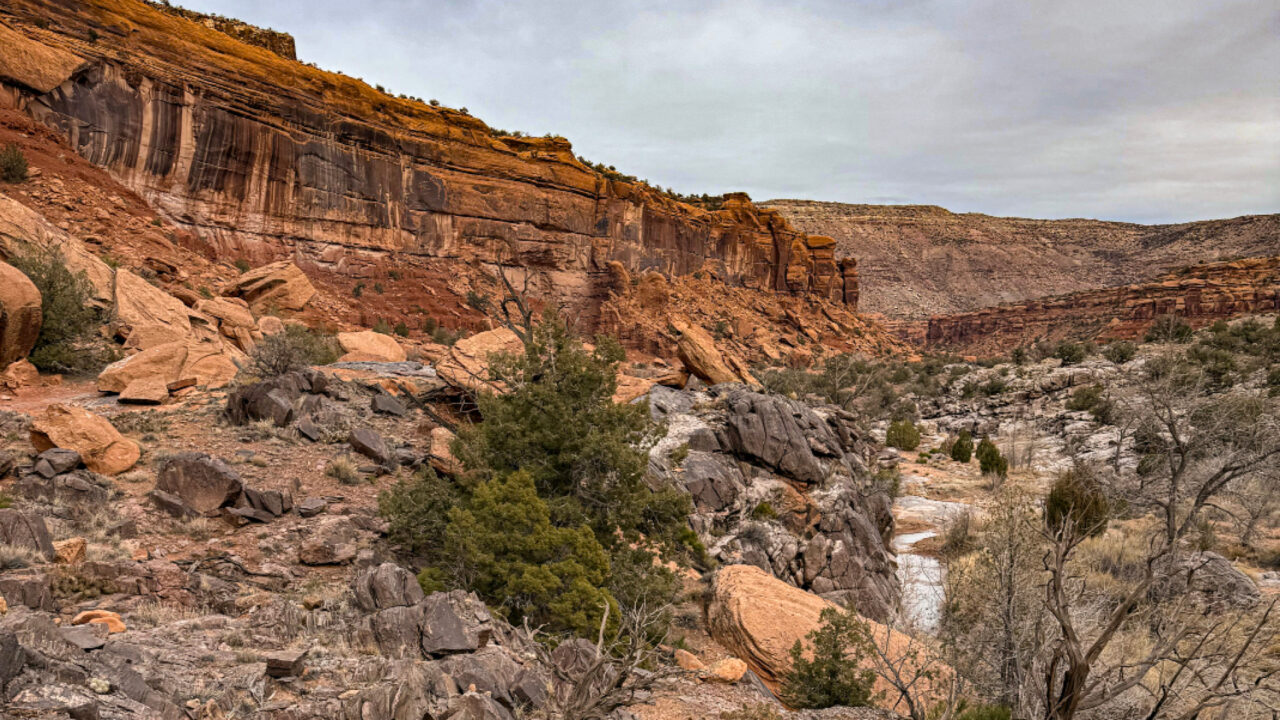
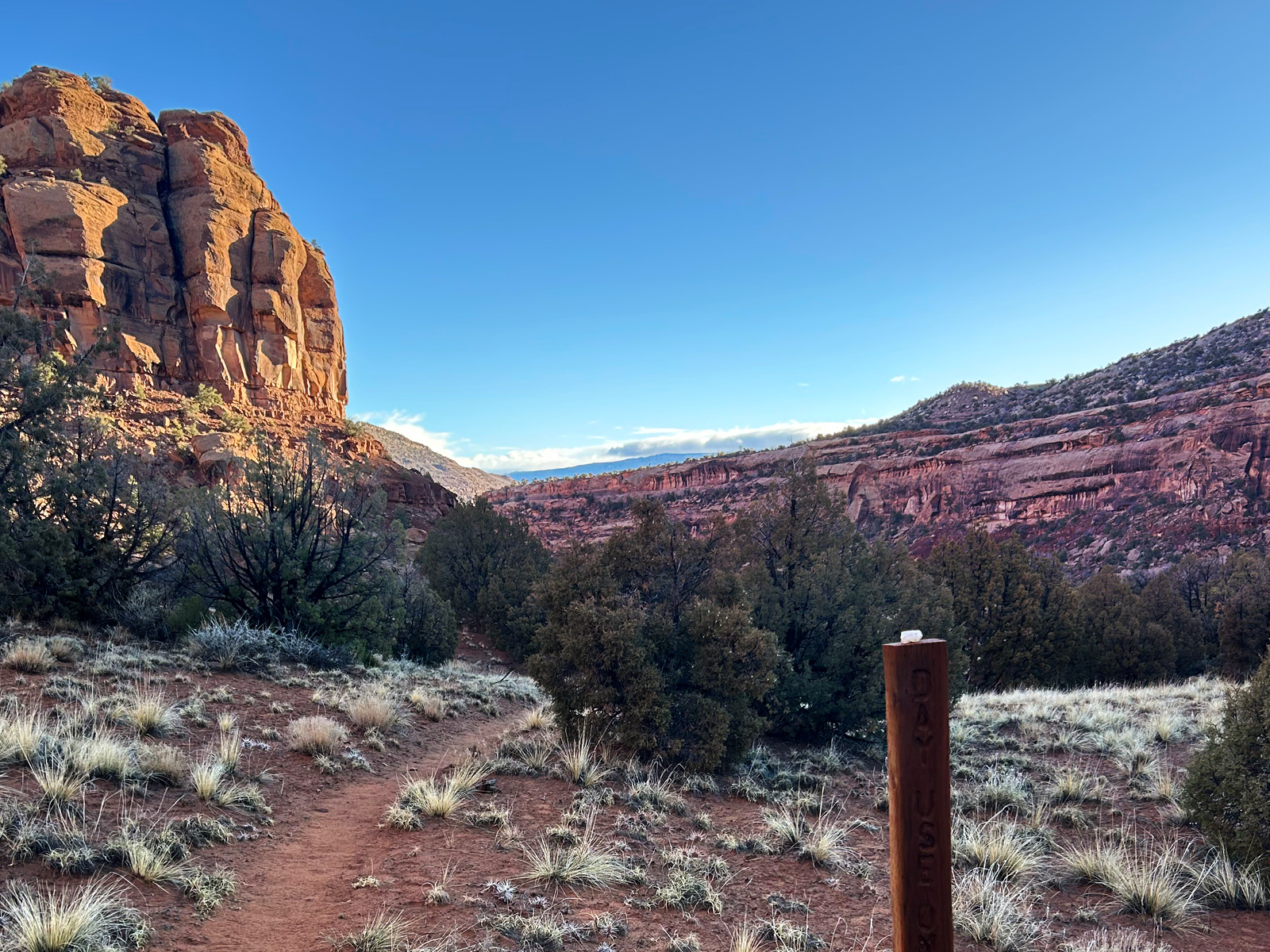
We hiked deeper into the canyon on a faint piece of singletrack, the orange sandstone contrasting against cobalt sky. After another mile, the canyon swallowed us whole, its sheer walls stretching 400 feet above us. The trail undulated above Big Dominguez Creek on a wide shelf, offering up an embarrassment of arches, rock art, and sandstone fins like small aeries. As the oh-wow moments piled up, my skepticism burned off with the February frost.
In the early evening, seven miles from the trailhead, we ducked inside a small rock shelter. Tin food cans, metal piping fragments, and a handprint stained on the wall at head height revealed that I wasn’t the first person to decide this was a good stopping point. From the cavern, a thread of trail slipped past rusted mining equipment toward the creek.
Jessica and I clambered over a metal grate covering an abandoned prospecting pit to reach the water. There, a grove of cottonwoods and box elders shaded half a dozen established campsites, each vacant. We selected a small clearing that backed up to trees with domed coyote willows on either side. A vague track led to the water’s edge, where Big Dominguez Creek sluices through a rocky flume on its way to the Gunnison. It was the perfect campsite.
What wasn’t perfect was that I didn’t want to stop hiking. We had, I estimated, 40-something miles to go if we were going to complete the loop, and we’d promised our loved ones our safe return in three days’ time. (Thirty-five miles, this trip is not.) We still had a couple of hours of daylight. Jessica and I sat on a cottonwood trunk—sheared and flat, an ideal cook station—and discussed our options. We investigated the map; from here, the trail southwest through Big Dominguez Canyon stayed high on the shelf, with no obvious entry points back to the creek. We’d need to top off our water and haul enough for the night and the following day’s hike. We drummed up a weather forecast from my GPS unit. Rain tomorrow, snow in two days.
We stayed.
In the morning, Northern flickers chattered while I boiled water. The rising sun touched the sandstone cliffs behind our tent, and the evening chill began to lift from the sandbar. The creek rushed through the box canyon. We ate instant oatmeal from small brown bags and sipped gritty coffee from our mugs. We broke down camp in silence. Talking felt like vandalism.
We moved slowly back to the main trail. We were sore; Jessica hadn’t backpacked before, and I hadn’t, like this, in five years. My shoulders ached, and my hamstrings felt like Jell-O. I tried to crack a joke about the metal grate over the prospecting pit that she deftly navigated the afternoon prior (which I, in my abundant wisdom, attempted to circumvent, only to turtle-shell on my 50-pound pack in the barbs of a juniper shrub). “Should we go your way today?” I asked. She harrumphed.
The route through Big Dominguez Canyon was no less beautiful than it had been the previous day—wending singletrack through the high desert that bisected tall canyon walls and was pocked with shrubs and occasional petroglyph panels—but the magic had drained away. We were beat, our pace reduced to a stubborn trudge. The next campsite felt less like a destination than a mirage, something that might materialize around the next dogleg and never did. “The desert says nothing,” Abbey wrote in Desert Solitaire. “Completely passive, acted upon but never acting.”
By the time we drop our packs and scrabble onto the charcoal-colored slab of schist, some 17 miles into Big Dominguez Canyon, the illusion of ease, whatever comfort we had found beside the creek last night, has long since burned off. We need to make a call. I choke down a couple of bites of tuna salad and pull another weather forecast, hopeful the storm currently pummeling Eagle County has let up. My heart sinks as my GPS unit flashes a pair of 100s. Rain tonight. Three inches of what will almost certainly be very wet snow tomorrow. Jessica, cautiously, asks me what I want to do.
As with most real-world problems, I can convince myself both ways. Part of me wants to beat the deluge and push on to the next campsite, where the dotted line on our topo map finally reconnects with Dominguez Creek. It’s the commitment point where we anticipate fording the water and negotiating a way, off trail, across the Creamsicle-shaded rampart that separates us from Little Dominguez Canyon. It’s at least three hours ahead of us, probably more. Who knows when—if—I’ll ever get another crack at it.
But I don’t want to be on this desert roller coaster of a trail when it turns into a lethal Slip ’N Slide, and I don’t want to manage the canyon transfer—the off-trail bit, for which I have no reliable beta—in snow. Retracing our steps feels like the smarter play.
Back at our desert oasis, we swig whiskey from a flask and let a campfire warm our faces. The stars begin to pop like kernels in the twilight, and our laughter bounces over the cobbles. It’s easy to believe the canyon belongs to us.
I’d wanted the full loop, the clean line I’d drawn on my GPS unit, the tidy story. But sitting here, it’s clear how little that matters. Turning back feels more like a correction than a concession—a reminder that the point was never to finish, but to notice.
I tell Jessica I can’t wait to come back, maybe in May. She asks if I’ll go for the 50-miler when I do, and I surprise both of us when I say I want to return to this very spot. I want to sling a hammock between the cottonwoods, to splash in the swimming hole when it’s 80 degrees, to see the gilia blooming fiery red and monkeyflowers lining the creek. I bet there’s mint around here—I could fashion backcountry mojitos next time. I want to scramble out of the canyon and see how many fourteeners I can name.
I wonder if telling this story will give the place away, that there might be people around when I come back. I can’t be sure, but I doubt it. The Dominguez Canyon Wilderness is overshadowed by a regional menu that includes Utah’s national parks, Moab, the Elk Mountains, and Colorado’s lineup of fourteeners. It’s too remote, too intense to attract crowds. The tricky navigation and long stretches without water will still be deal-breakers for most hikers.
So this canyon will remain lonely for the few souls who are stubborn enough—and curious enough—to wander into it anyway. If you’re one of them, you probably already know it.