


The Local newsletter is your free, daily guide to life in Colorado. For locals, by locals.
As artillery echoed through the bitter winter air of eastern Ukraine, Courtney Pollock fought for sleep on a stretcher inside her ambulance, parked on the last passable road before the front. It was December 2022, and Pollock was on her second trip to the war-torn country. Just a few kilometers away, across frozen fields, Russian forces were bombarding Bakhmut with as many as 50,000 artillery shells each day, according to Ukrainian officials. By the time Russia captured the front-line city in May 2023, a metropolis that had once been home to 70,000 people would be reduced to ruins.
Pollock was a 38-year-old paramedic from the United States. The Colorado native had first journeyed to Ukraine the previous May, three months after Russia launched its full-scale invasion. “From my life experiences, I knew that there were needs that I could help with,” Pollock says. She’d returned that December with Global Outreach Doctors; Pollock’s job was to triage soldiers and civilians and transport them to treatment facilities.

A few days after New Year’s, at the end of a long shift, Pollock retreated to an empty casualty collection point, a former kindergarten classroom. She was soon approached by a man she’d met earlier at a mechanic’s warehouse that served as a humanitarian base. He’d introduced himself as Swampy. She’d made note of his blue eyes—and British accent. He offered her a cup of tea. He removed his helmet, revealing a bearded face and scraggly, sandy hair.
Pollock had heard about Swampy. Originally from the Isle of Man, a small island between England and Ireland, Chris Garrett was an explosive ordinance disposal technician—he cleared landmines. Mutual friends told Pollock that Garrett’s experience made him a good man to know. Pollock had reservations; foreign fighters were a rowdy bunch, often escaping problems back home. Garrett had tattoos of explosives and the Ukrainian word for sniper running down his arms. A skull and crossbones, framed by the warning “DANGER: MINES,” covered his back.
The two swapped stories that night before parting. Over the next few weeks, Garrett and Pollock grew close, the harried pace and stresses of war accelerating their intimacy. “Seconds are weeks, days are years…. What you see or experience becomes ingrained and a part of you instantly,” Pollock says. “Relationships are formed faster in this type of environment.” They occasionally traveled together on missions. He fitted blast protection blankets on windows and oxygen tanks inside Pollock’s ambulance. Garrett sent text messages when they were apart.
Some were flirtatious, and he always signed off with “x” or “xx.”
Before Pollock boarded a train that would take her to Poland, the first leg of a journey to the States for a friend’s funeral, her team gave her a Ukrainian flag. On it, Garrett wrote a message: “If all roads brought us here, imagine where here will take us next.”
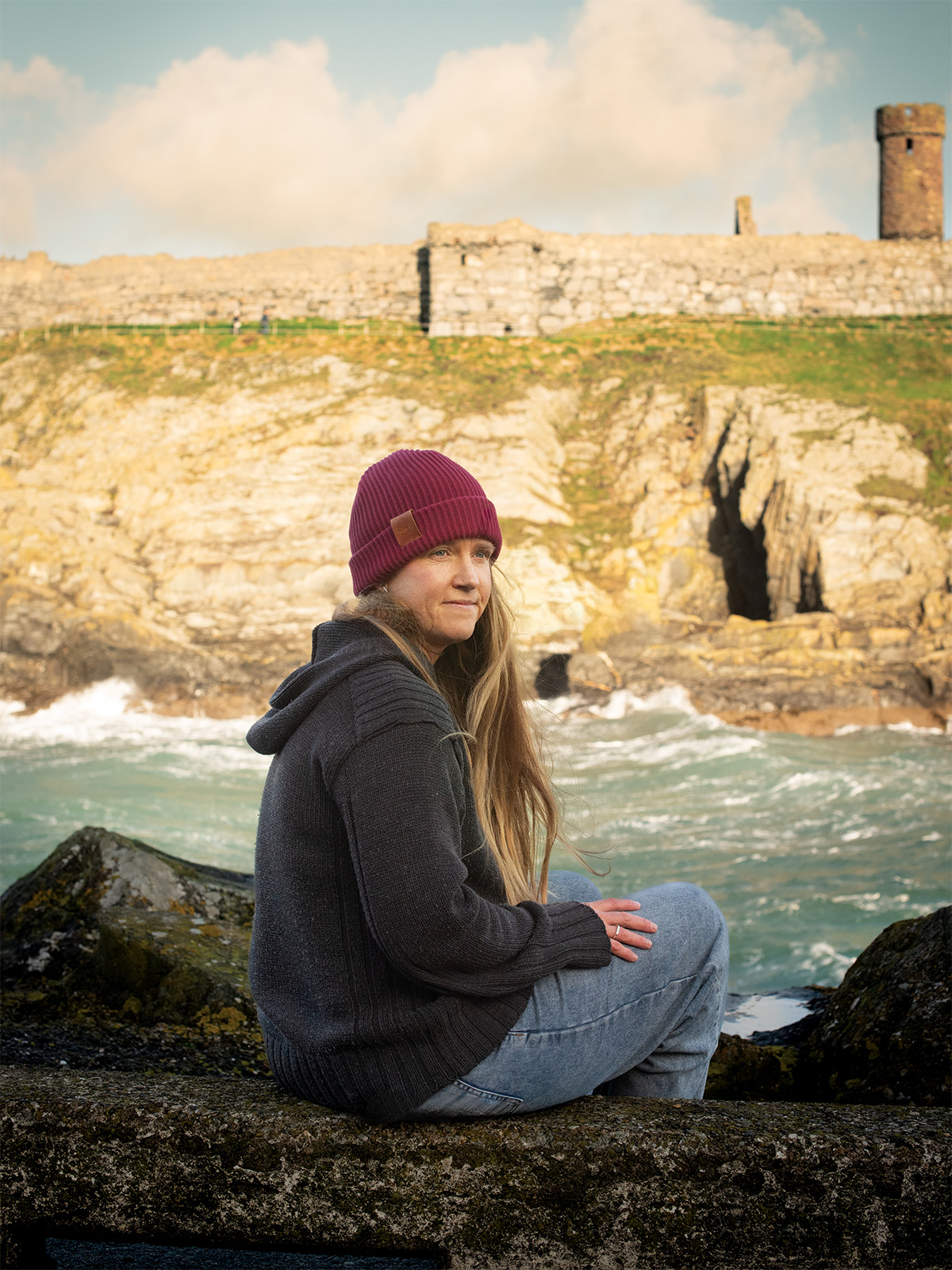
Born in Boulder and raised in Westminster, Pollock was a competitive swimmer and recreational skier, but at Pomona High School in Arvada, she was drawn to the marching band. “I think that jump-started my whole life,” Pollock says, “being in a team environment and uniform and working toward a big common goal.” In 2004, she found the same structure in the Colorado Air National Guard. Pollock deployed to Iraq three years later, planning missions and leading briefings and debriefings for the Air Force’s 332nd F-16 unit.
Pollock returned to Colorado in 2008, intent on becoming a combat pilot. She obtained a recreational license, but military flight physicals revealed Pollock had supraventricular tachycardia, a condition that causes an accelerated heartbeat. A surgery to repair the abnormality failed, and doctors implanted a pacemaker—ending her dream of flying F-16s. “It sent me on a whole crazy spiral,” Pollock says.
Inspired by her health struggles, Pollock became a nursing assistant and took prerequisite courses for a physician’s assistant program, then made a series of U-turns: restaurant server, horse-sleigh driver, event planner, office manager, ski patroller. Her parents moved to Utah in 2017, and she followed a year later. During the pandemic, she lost her job as a food and beverage manager at a ski resort in Eden, Utah, and began mowing fairways at a golf course. “It allowed me to really think about what I needed to do with my life,” Pollock says. “I realized I missed helping people.” Pollock retrained as a firefighter and paramedic and joined Utah’s Weber Fire District in February 2022—the same month Russia launched its full-scale invasion of Ukraine.
Garrett also took a wayward path to Ukraine. Like Pollock, he’d spent much of his childhood outdoors—hiking, fishing, and sailing around the island. At 16, he joined the Army Foundation College, a quasi-prep school for the British Army, but his military career ended when he suffered a heel injury while rock climbing that disqualified him from service. He fell in with a bad crowd, and in 2003, when he was 19, Garrett robbed a gas station. His father died from cancer while Garrett served an 18-month sentence. Upon his release, Garrett trained as an arborist and earned the nickname Swampy.
Five years later, Garrett saw an opportunity to revive his military ambitions after reading about the Karen National Liberation Army. The conflict was in Myanmar, where his grandfather had served in the Burma Campaign during World War II. Rather than fight with the soldiers against the country’s military junta, Garrett volunteered to clear landmines. He continued his service from there. Between 2014 and 2017, he fought with Ukrainian forces against Russian separatists before again switching to mine disposal and education, cooperating with government agencies to clear hundreds of tons of explosives. He returned to Ukraine four days after Russia’s invasion in 2022.
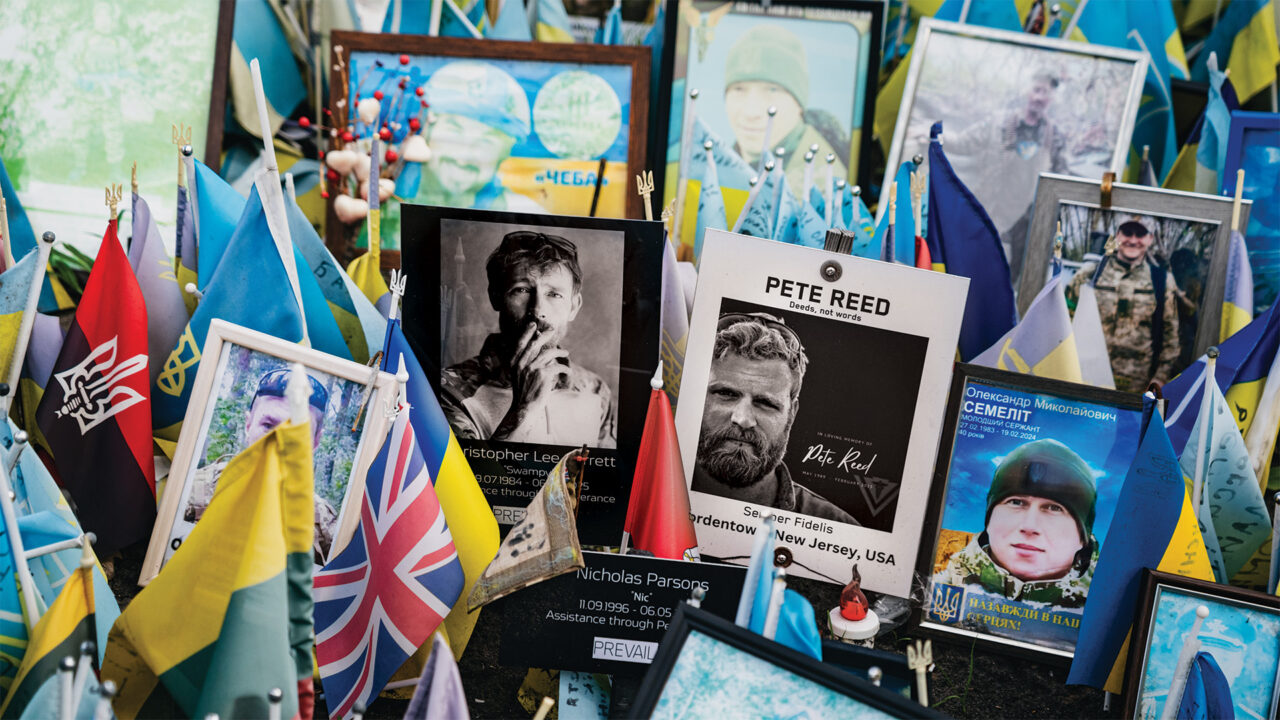
His expertise and charisma made him a celebrity. Garrett attracted nearly 25,000 Instagram followers and appeared frequently in the media to talk about Ukraine’s mine crisis. His reputation also made him a target. This past March, a separatist-controlled court in the Donbas convicted Garrett in absentia of terrorism, sentencing him to a 14-year jail sentence should he set foot in Russia or be captured in Ukraine. Garrett described the ruling as “a pathetic attempt to smear [him],” adding that his role lay in “preserving life, not taking it.”
By the time Pollock and Garrett met in that classroom, both were exactly where they wanted to be: wandering in a war zone, but no longer lost. “We understood each other in a way that made it comfortable for each of us to continue being the people we always had been,” Pollock says. “We didn’t have to change. We didn’t have to lie to ourselves or each other.”
Read More: On the Front Line: Embedded With American Female Combat Soldiers in Afghanistan
On the train to Poland, Pollock began receiving cryptic messages from Garrett. Did she know where Pete Reed’s passport was? Did Reed have any identifying tattoos?
Reed was a former U.S. Marine from New Jersey who led Global Outreach Doctors’ Ukraine operations and founded his own humanitarian outfit, Global Response Medicine, which has treated more than 200,000 patients around the world. Reed was Pollock’s boss, but the two hadn’t met in person until that month, January 2023. “We hugged and from that moment, he was like an instant brother to me,” Pollock says. Over the next two weeks, they coordinated medical evacuations, transporting civilian casualties of missile and drone strikes and injured soldiers. They sang Queen’s “Bohemian Rhapsody” to pass the time and to keep their morale up on their drives. They slept in their ambulance on the side of the road, Pollock on a stretcher and Reed on the floor.
Through the patchy signal, Pollock learned Reed had been injured after Russians targeted his rescue vehicle with what later was determined to be an anti-tank missile—a war crime. She left the train in Poland and boarded the next one heading back east. Soon, it was confirmed. Reed was dead.
Pollock fell apart when she reunited with Garrett. “That’s the first time I’ve ever sat and truly cried with somebody else,” she says. “It was the most raw and the lowest that I’ve ever been with another human.” Reed had encouraged Pollock to return to the United States for her friend’s funeral; if she hadn’t boarded that train, she could have been killed alongside her friend. “It’s a lot to think about,” she says now. Days later, Pollock and Reed’s wife got memorial tattoos. Reed always wore a patch that read “Deeds Not Words.” Pollock got the phrase inked on her left arm and “Anywhere the wind blows” on her right—both in Ukrainian.
On the day of Reed’s funeral, Pollock’s and Garrett’s lives took a new turn. “I found out I was pregnant and had to figure out how to tell Chris,” Pollock says. “Even before we became a couple, we’d talked about how what we’re passionate about did not lend itself to a family lifestyle.” Pollock believed she would never hear from Garrett again, but instead he began formulating a plan for them to be together. “I thought: This might be my only chance—maybe this happened for a reason,” Pollock says.
The couple moved to the Isle of Man, and they began outfitting a shipping container in which their growing family could live. Garrett proposed in May 2023 while they were attending an event supporting Ukraine’s war effort. For once, the two were dressed up and “all fancy,” Pollock says. She said yes. One day, while texting with friends back in Ukraine who needed assistance, Garrett put his phone down and looked at Pollock. “We need to start our own organization,” he said.
Pollock and Garrett founded Prevail, a humanitarian, medical, and demining charity, in August 2023. Their daughter, Reed Elliott Garrett, arrived three months later. And in February 2024, the second anniversary of the invasion, they returned to Kyiv, with their daughter in tow. “It was the most difficult decision of my life,” Pollock says. “I worried every day. I knew the risks. But I also knew our mission.” While Garrett focused on demining and mine education, Pollock managed an ambulance team, procured medical supplies, and organized aid to front-line towns.
Three months later, in spring 2024, a missile hit close to their Kyiv home. The risk suddenly felt intolerable. Pollock and Reed left for Utah. Garrett stayed behind. Living apart wouldn’t be permanent. Within three years, they hoped to hand the organization to locals and travel on a boat. Perhaps they’d settle in New Zealand—or a peaceful, free Ukraine. “We had an exit plan,” Pollock says. “But Chris was raising our organization in a war zone while I was raising our daughter—and it sucked.”
A year later, Pollock was at her sister’s home in Idaho—a final visit before moving permanently to the Isle of Man. She had just sat down for breakfast when she received a call from Shaun Pinner, a Prevail board member.
“There’s no easy way to say this, but Chris is 200,” Pinner said, using a military code for deceased.
The line dropped. He called again. “I don’t understand,” Pollock replied.
“There was an accident,” Pinner said. “Chris is gone.”

Two weeks after his death, Pollock stood on a beach in Garrett’s hometown of Peel. Dressed in military green and smoking a cigarette, she seemed composed. Ukrainian tattoos ran down her arms. A bracelet engraved with “Deeds Not Words” hung around her wrist. Her voice was sincere, strong. “You never want to think about memorial benches, renaming a pier after him, or where to scatter his ashes, but it keeps your mind occupied,” she said.
Garrett was killed on May 6 while on a demining mission in eastern Ukraine, near the city of Izium, alongside his Australian colleague Nick Parsons. Although she knew the dangers of Garrett’s work, Pollock still struggled to accept that he was dead. “I remember falling and screaming ‘no’ a thousand times,” she says. Pollock then had to gather herself and call his friends and family. Eighteen-month-old Reed tried to comfort her mother with hugs.
Pollock and her daughter traveled to a memorial service in Kyiv’s Independence Square, attended by hundreds who stood through heavy rain. Reed—wearing a blue dress and yellow raincoat and clutching a toy koala—watched as people lay wreaths below a black-and-white portrait of her father. Afterward, Pollock and Reed carried Garrett’s ashes to the Isle of Man, where they were met by an honor guard of Ukrainian refugees bearing flags and hundreds of locals lining the streets.
Pollock spoke directly to Garrett at a service in Peel:
“I promise you, you will be proud of everything that follows this day, maybe not in the moment, but always in the outcome. I promise to make sure Reed knows how to fish, but more importantly, how to catch. I promise she will sail boats and fly planes. I promise Reed will know how to take care of herself and others. I promise Reed will be an amazing human. And finally, I promise Reed will know who her father was.”
As peace talks drag on and Russia intensifies its attacks, Prevail’s mission remains vital. More than 2,700 people have participated in the nonprofit’s mine-education programs, but more will be needed: Garrett believed Ukraine’s demining effort would outlive its current residents. Prevail’s team of eight to 12 volunteers has evacuated more than 1,300 wounded and raised about $180,000 for medical and demining operations. Pollock decided within days of Garrett’s death the charity would continue. “There’s no way he would have wanted it to stop,” she says.
Pollock does most of her work from the Isle of Man, where she now lives with Reed. But at press time, she was planning to return to Ukraine to meet with hospitals and doctors who might assist her team. Reed will go with her. Since that missile landed near their apartment in Kyiv, Pollock refuses to be separated from her daughter. “If something happened to her and not me, I wouldn’t be able to live with myself,” Pollock says. “Now, preparing to go back into Ukraine, I am taking her with me. The sole thought here is that I will not orphan my child. Read into that as you may.”
In the months following Garrett’s death, Pollock has repeatedly told herself: It wasn’t supposed to be like this. At the same time, she thinks, All roads brought us here. “I don’t know what I believe in,” Pollock says, “but Reed’s a special little girl who is supposed to be here.”
This story was supported by the International Women’s Media Foundation’s Women on the Ground: Reporting from Ukraine’s Unseen Frontlines Initiative in partnership with the Howard G. Buffett Foundation. Liubov Sholudko assisted with the reporting.