

The Local newsletter is your free, daily guide to life in Colorado. For locals, by locals.
Matt McCormick joined the St. Francis Center as an intern in 2016. He eventually became a full-time staffer for the Five Points day shelter, handing out jackets during snowstorms, helping people fill out applications for housing, and watching as apartment buildings went up and affluent neighbors moved in.
He also saw the number of people experiencing homelessness in metro Denver nearly double from 2016 to 2023, reaching 10,054. The rise led to frustration with former Mayor Michael Hancock’s handling of the issue, and that year voters elected a new mayor, Mike Johnston, who promised to end unsheltered homelessness during his first term. One of his first moves was to convert the Comfort Inn on Quebec Street into a shelter for individuals and couples.

McCormick joined the St. Francis team tasked with managing the former hotel. Shortly thereafter, he noticed that an anonymous social media profile was frequently mentioning the Comfort Inn on X and Instagram. “At the end of the video you’ll see a drug addict gathering in between the Meth Western and Discomfort Inn,” the account posted on Instagram on October 4, 2024. “This is further proof that housing will NOT solve the drug addiction crisis that Mayor @mikejohnstonco refers to as ‘homelessness.’ ”
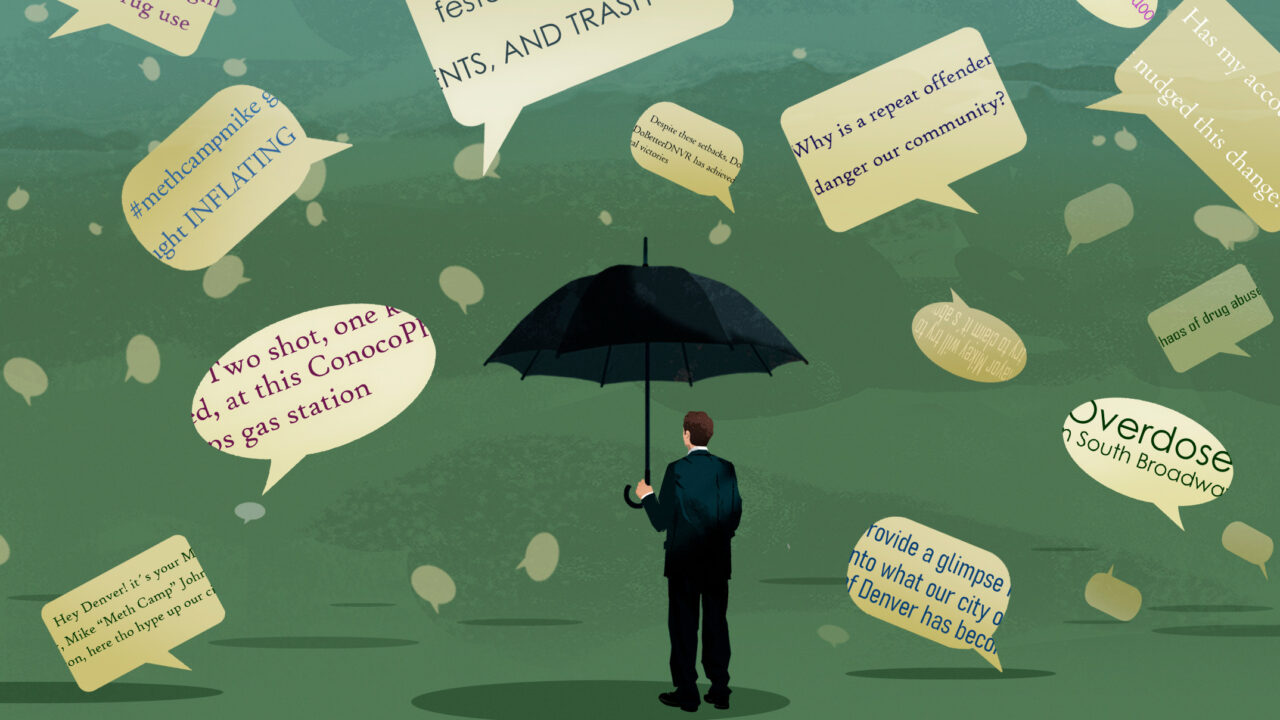
The pundit called itself DoBetterDNVR and did not limit its criticism to the Comfort Inn. It used crowdsourced videos and photos to call attention to encampments (“This area is festering with RVs, tents, and trash that the city has enabled to grow unabated for months”), denounce public drug use (“Quite the scene outside of this #colfax @mcdonalds!!”), and attack Johnston (“Seems like I am a [sic] better at budgeting than the city…Or perhaps #methcampmike got caught INFLATING the budget and had to backtrack”).
McCormick says he saw people he knew—both clients and co-workers—targeted by the account. He tried to ignore DoBetterDNVR, but the profile was growing fast, with about 150,000 followers on Instagram and X by July 2025. “I would check and see what they were saying,” McCormick says, “which always seemed to be angry diatribes—nothing but complaints, complaints, complaints.”
So when, in August, he read that the Denver Post had uncovered the identities of three contributors to DoBetterDNVR—which was posting daily on Instagram and X—McCormick logged on to TikTok inside his office and hit record. “Did y’all see the Denver Post?” he asked with a smile. “DoBetterDNVR is evil. If you follow them, you’re evil. If you contribute to them, you’re evil. And if I ever, ever catch any one of y’all who have contributed, or follow, I’m fighting you.”
McCormick then forgot about the post for a few days—until an account he’d never heard of called Hydra Echo posted both his address and LinkedIn profile on TikTok. DoBetterDNVR had seen his video and called on its followers to email complaints to St. Francis Center’s human resources department. The shelter ultimately fired McCormick for violating the nonprofit’s policy against using social media at work and for using threatening language online.
DoBetterDNVR celebrated the victory. “Perhaps [Matt] should take the blame on this one,” the account crooned on X on August 6, in a post that received 1,300 likes and 237 shares. “He made a TikTok threatening violence on followers of DoBetterDNVR from his office at the shelter. BuhBye.”
“I was joking,” McCormick says.
DoBetterDNVR may have the power to marshal thousands of followers today, but its first post—an Instagram missive on June 29, 2021, that announced its intention to “provide a glimpse into what our city of Denver has become and how it is worsening by the day,” accompanied by a photo of an empty Fireball shooter next to abandoned bags and clothes strewn on a sidewalk—got only nine likes.
Locals continued to ignore DoBetterDNVR until July 2023, when two changes marked a major turning point. First, newly elected Mayor Mike Johnston made homelessness his top priority. His campaign pledge to end unsheltered homelessness was an ambitious goal—one his predecessors had spent millions trying and failing to accomplish. Johnston’s plan was to implement a housing-first strategy by using pandemic relief money and tax revenue from the state to either build new transitional housing units or acquire underutilized hotels. Once people were sheltered, the city could connect them with services to get them on their feet.
Second, someone new took over DoBetterDNVR, according to a 2024 Westword article. Previously, a collective had run the account. While contributors still provided photos and videos, both the frequency and tone of the posts changed under the new, unnamed administrator. The account rolled out Trump-style epithets, dubbing the mayor “Meth Camp Mike” and another hotel-turned-shelter the “Embezzley Suites.” One video from April 2024 showed a baby crawling across a sidewalk in downtown Denver, away from its apparently oblivious mother. DoBetterDNVR also got personal. A post from earlier this year showed a photo of the mayor’s wife, Courtney Johnston, next to a picture of Gollum from The Lord of the Rings movies. “Courtney Johnston is lookin’ a lil rough today,” the caption read. The post attracted more than 10,000 views.
(As a producer for City Cast Denver, a daily news podcast, I’ve exchanged DMs with DoBetterDNVR over the years. It’s even come up with a nickname for our show: Shitty Cast. But the admin declined to participate in an interview for this story.)
The harsher the tone, the more visceral the videos, the more popular DoBetterDNVR became. Its combined Instagram and X followers grew from 3,000 to more than 40,000 during the first eight months of Johnston’s term, according to Westword.
“What I appreciated about it is this abrasive citizen journalism,” says Jeff Hunt, the former chairman of the Western Conservative Summit who co-hosts a talk radio show on 710KNUS. “You get an unfiltered view of what’s really happening in the communities you live in.” That street-level perspective is especially appealing to conservatives, says Hunt, citing a recent Gallup poll that reported only eight percent of Republicans have a “great deal” or “fair amount” of trust in traditional media.
The first post Heidi Ganahl, the Republican candidate for governor in 2022, remembers is the baby crawling away from its mother. “It just broke my heart,” Ganahl says, “and I was like, God, I cannot get that image outta my head.” Ganahl says she didn’t see the Gollum post; when I showed it to her, she called it “bad” and “not necessary.” In general, though, she is “rooting for DoBetterDNVR to be hard and edgy and fearless about telling these stories.”
In July, DoBetterDNVR accused the mayor and police of masterminding an alleged “off the books” investigation to unmask the account. As evidence, the account posted screenshots of an open-records request made by the Denver Police Protective Association, the collective bargaining agent for officers. The DPPA had asked for internal Denver Police Department emails related to DoBetterDNVR. According to the admin, the search turned up 4,356 relevant messages. Their contents remain a mystery (no one, it seems, is willing to pay the $5,951 the DPD requires to process the emails, and the DPPA did not respond to 5280’s interview request). The DPD and mayor’s office denied the allegation, but the mere perception of impropriety started a firestorm.
It began with a few anonymous accounts picking up the conspiracy. After DoBetterDNVR alleged that the Denver Post was in on the plot and working on a story that would out DoBetterDNVR’s identity, Ganahl, Hunt, and other local conservative leaders joined in, too, posting the message, “I am DoBetterDNVR.” (In the 1960 film Spartacus, the title character’s followers prevent their leader from being identified by shouting, “I am Spartacus!”)
Hunt admits he never saw a “smoking gun” of evidence for the scheme, only “a lot of smoke.” Little of it cleared after the Post published its story on August 1. Reporter Shelly Bradbury was able to identify three contributors to DoBetterDNVR by connecting open-records requests they’d made to information that later showed up on one of its accounts. All three denied being the admin. A person purporting to be the admin then gave a few anonymous interviews to conservative publications, claiming their identity was still secret.
“I really do think the fact that they are anonymous is better than if we knew who it was,” says Valdamar Archuleta, a Republican who ran unsuccessfully for Denver’s congressional seat in 2024 and participated in the “I am DoBetterDNVR” crusade. “Without being able to put it on one person or two, it becomes the voice of a movement.”
You’d expect conservatives like Hunt and Ganahl to support a vocal critic of Denver’s Democratic mayor, but DoBetterDNVR’s power seems to come from an ability to tap into a vein of shared discontent.
Ted Trimpa is one of the state’s most celebrated Democratic strategists; he advocated effectively for the national legalization of gay marriage and helped the Democrats achieve a majority in the Colorado Legislature in 2004 and 2006. A few years ago, he relocated to a luxury apartment downtown, after his husband moved to New York City to take a job with Fox News. “ My MAGA husband will forward me [DoBetterDNVR] posts to say, See, I told you so. Democratic mayor in a Democratic city, and this is what happens,” Trimpa says, looking out his window over Union Station. “To which I just roll my eyes.”
But Trimpa concedes that DoBetterDNVR isn’t necessarily wrong—they just depict a distorted, mostly outdated view of the truth, he says. “Were there people shooting up outside my building when I first moved down here?” Trimpa says. “Yes, I saw it, but I also didn’t look around and say, ‘Oh, my God, that’s what all of this neighborhood is about.’ ”
Trimpa thinks the mayor has made enormous progress downtown since then, and at least some data points support that. During his State of the City address this past July, Johnston pointed to a 45 percent drop in unsheltered homelessness during his tenure. The Urban Institute recently reported that the mayor’s efforts have effectively reduced the number of encampments with 20 or more people by 98 percent. Denver’s homicide rate fell 45 percent through July 2025 compared to the first six months of the previous year. Car thefts were down 46 percent. Johnston acknowledges that he has not ended unsheltered homelessness in Denver, but he believes these statistical leaps are milestones on the road to a thriving city.
Rather than credit Johnston with these wins, Trimpa says, DoBetterDNVR sensationalizes grim, individual scenes. “The plural of anecdote is not data, and what they’re trying to do is just that,” Trimpa says. “A bunch of clips which ‘prove’ something.” Specifically: that downtown Denver is a hellscape of crime, homelessness, and public drug use.
Johnston’s depiction of the city is, of course, a bit rosier. It seems he simply can’t sell his version of Denver—at least not enough to convince people that downtown is a safe place to spend their money. Earlier this year, the mayor announced a $250 million budget shortfall, citing, in part, the sluggish return of sales tax revenues following the pandemic, especially from businesses downtown. The city ordered furlough days and laid off 171 employees to help close the deficit. “It’s not only on him, but at a certain level, it is [Johnston’s] responsibility,” Trimpa says of downtown’s lackluster PR. “I personally have issues with some of the [mayor’s] focus, and I think that it appears that business in downtown was not first on the list and maybe a little too far down on the list.”
Johnston has recently made efforts to rectify that. Last November, he persuaded voters to expand the Downtown Development Authority, which uses tax increment financing to fund projects that will help accelerate economic growth. This past April, he created an office to help streamline the process for new businesses to get permits approved. At the end of May, he worked with the Downtown Denver Partnership to throw a two-day party celebrating the reopening of 16th Street following a three-year renovation.
Still, more Denverites have soured on Johnston. According to an August survey from the Colorado Polling Institute, 46 percent of eligible voters have an unfavorable view of the mayor, up from 38 percent a year ago. Their top concern? Homelessness, at 44 percent. Alex Renteria, the mayor’s director of communications, is quick to point out that the same poll showed that, compared with two years ago, more voters (51 percent to 44 percent) feel Denver is headed in the right direction. “But that’s fair,” she says of the mayor’s favorability rating. “We have more work to do to tell that story.”
For Hunt, the budget shortfall shows that Denver is still too soft on crime and homelessness and too quick to spend on the wrong things. “So now you have a strong incentive to clean up the city in order to drive sales tax,” Hunt says.
Sure enough, during his 2025 State of the City address, Johnston mentioned a new focus on “quality-of-life crimes—like theft or public drug use—that impact many of us on a daily basis.” DPD Chief Ron Thomas later told Denverite that the policy shift was, in part, a recognition that these types of offenses have a large impact on “people’s perceptions.”
“Has my account nudged this change?” DoBetterDNVR posted on August 25. Days later, Johnston announced that, as part of his proposed budget for 2026, he planned to close two shelters, including the converted Comfort Inn that had been the object of DoBetterDNVR’s ire, saving $11 million.
Renteria rejects any implication that the mayor is taking notes from DoBetterDNVR or moving in a conservative direction. She says this was always the plan. Now that fewer people are living on the streets, the mayor is simply shifting his focus to mental health services and longer-term workforce development. According to Renteria, the people still living unsheltered on Denver’s streets—the group often maligned for acting strangely or saying threatening things—have refused the support offered so far. “When you’re walking on the street going to lunch or with your child and you see that,” Renteria says, “you’re gonna feel unsafe.”
Charlie Kirk was killed while speaking at a college in Utah on September 10. The assassination of the conservative activist sparked a multitude of commentary about the escalating hostility in American politics—and made DoBetterDNVR reconsider their role in it.
In mid-September, after I noticed that the admin hadn’t posted in a few days, I reached out. I was curious about the pause, but I also wanted to know their thoughts on the mayor’s shifts on crime and homelessness. “Mike Johnston tells people what he thinks they want to hear, which I guess these moves are a good indication of what he is hearing from voters,” they responded. “Nevertheless, I sincerely doubt he is planning on doing anything to meaningfully address either issue. I hope I am wrong.” They also told me they were only taking a break from social media because their real-life job had gotten too busy.
The next day, DoBetterDNVR disappeared. Conservative columnist Jimmy Sengenberger of the Denver Gazette posted a statement from the admin shortly thereafter, confirming that DoBetterDNVR had removed their Instagram and X profiles under their own volition and not, as some of their supporters had speculated, under threat from Johnston or the police.
When I called Sengenberger, he mentioned a past interview during which the admin had indicated they felt unsafe. Sengenberger was also feeling unsafe after Kirk’s murder: “ We are in a moment where violence is a possibility.”
Then, on September 25, DoBetterDNVR was back—but different. In a post explaining the two-week absence, they acknowledged they had not always been accurate or constructive and apologized for the personal attacks on Mike and Courtney Johnston. When I DM’ed them directly, the admin said Sengenberger had been right: “Charlie’s assassination really impacted me and I had to weigh the risks on my personal safety vs. benefit of keeping the accounts…. Ultimately, you can see what I picked but going forward, I am not going to play a part in the unnecessary divisiveness and hostility.” They wrote that they planned to retire derogatory epithets, including Meth Camp Mike.
An hour later, they changed their mind. “Name-calling can sometimes be effective to emphasize a point,” they told me.
One person DoBetterDNVR isn’t going to apologize to is McCormick. “I hope Matt is doing well,” the admin wrote to me, “and that he’s learned a valuable lesson from the ordeal: to never threaten violence against anyone.”
When I spoke to McCormick this fall, he was taking time to reflect. He welcomes DoBetterDNVR’s rebrand—if the admin is interested in having a real conversation about solutions without denigrating people. McCormick wants to be a part of that work; he plans to launch his own social-services-focused communications agency. “That way,” he says, “the next time I get doxxed, I can’t get fired.”
Many DoBetterDNVR followers were suspicious of its more diplomatic approach. “Yo what? Never thought this page would be censored/intimated [sic] by our local government,” one wrote. But the account’s posts following its reemergence didn’t appear much different. There was a photo of a man using drugs, for example, accompanied by an argument against the Vibrant Denver bond package, which, if passed this month, would approve $950 million in debt for maintenance and infrastructure projects.
Conservative radio host Mandy Connell, who once cheered the account’s attacks on Johnston, says she sees a difference in tone and likes the new direction. “ When you realize that if someone killed you there would be a certain percentage of the population that would be overjoyed, it’s sobering,” Connell says.
“Oddly,” she adds, “I think [DoBetterDNVR] really wants to do better.”